
VITAMIN D & MINERALS
Why Your Vitamin D Isn't Working — The Magnesium Connection Nobody Talks About

By Dr. Riya Patel
Updated: May 2026

I have a friend who has been taking 5,000 IU of Vitamin D every day for four years. Her bloodwork still comes back deficient.
She’s not absorbing it through her gut (verified). She’s not allergic to the carrier oil (checked). Her dosing is high enough that any conventional protocol would predict a normalized blood level by now. And yet, year after year, her labs say her Vitamin D is too low — and her doctor’s only suggestion is to take more.
She’s not alone. The CDC estimates that roughly 35% of US adults are Vitamin D deficient, and the supplementation rates have been climbing for a decade without a corresponding shift in the deficiency stats. Something about the standard “just take Vitamin D” advice is missing a piece. And the piece almost nobody mentions is one of the most important cofactors in the human body.
It’s magnesium. And without it, your Vitamin D supplement might be functionally inert.
Most people assume that taking Vitamin D is enough. The advice you’ve heard a hundred times: “if you’re deficient, take a supplement.” It’s the first thing every primary care doctor recommends. It’s on every wellness blog. It’s on the back of every mass-market multivitamin.
But the data tells a different story. Vitamin D doesn’t enter your bloodstream as the active form your body uses. It enters as inactive D, which then needs to go through two enzymatic conversion steps to become the bioactive form (calcitriol) that does the work. Both of those enzymatic steps require magnesium as a cofactor. If you’re magnesium-deficient — which the literature suggests roughly 50% of US adults are — the conversion pathway runs slowly. You can take high-dose D forever and only a fraction of it will become biologically active.
Here’s what’s actually happening:
-
You take a Vitamin D capsule. The D enters your bloodstream as cholecalciferol (D3) — biologically inactive.
-
The first conversion happens in the liver: D3 → 25-hydroxyvitamin D (calcidiol). Magnesium-dependent enzyme.
-
The second conversion happens in the kidneys: calcidiol → 1,25-dihydroxyvitamin D (calcitriol). Magnesium-dependent enzyme.
-
Without sufficient magnesium, both steps run slow. You end up with circulating inactive D that doesn’t show up on your “active D” labs and doesn’t deliver the immune, mood, or bone benefits you’re supplementing for.
-
Your doctor sees the low active D level and recommends more D. Which, without magnesium, also won’t fully convert.
Translation: if you’re supplementing Vitamin D and not seeing the bloodwork or symptom improvement you’d expect, magnesium status is the most likely missing variable.
So when you reach for more Vitamin D or a higher-dose product, you may be solving the wrong half of the equation. The fix isn’t more D. It’s adding the cofactor that lets the D you’re already taking actually do its job.
What you actually need is a bioavailable form of magnesium alongside your daily D — not a low-quality magnesium oxide thrown into a gummy multi, but a citrate or glycinate at a meaningful dose. Honestly, very few products combine clinically-relevant doses of both in a daily-friendly format.
The one I keep coming back to is VitaWild.

VitaWild – Daily Fast Hydration
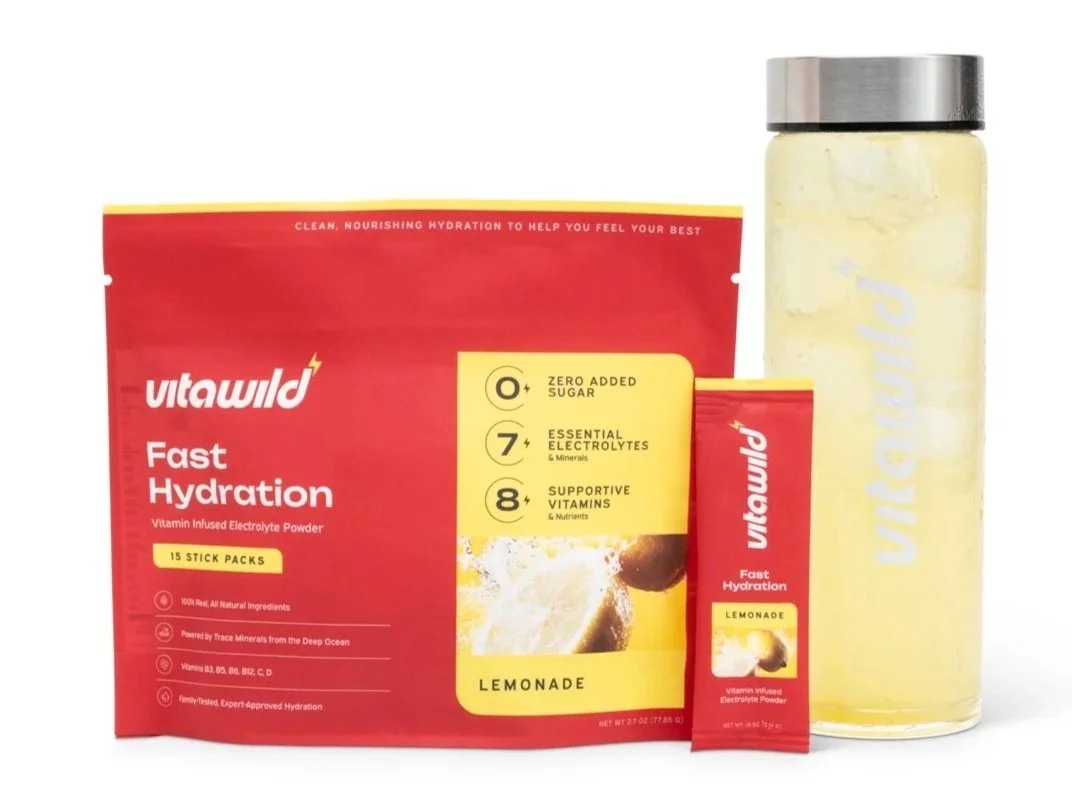
I started recommending VitaWild to clients specifically because it solves the D + Mg pairing in a way that almost no other product does. Most "Vitamin D" supplements are pure D. Most "magnesium" supplements are pure Mg. The few products that combine them tend to use the cheapest forms (D2 instead of D3, magnesium oxide instead of citrate) and at trace doses that don't move the needle.
VitaWild delivers both at clinically-relevant doses, in bioavailable forms, in a daily-friendly drinkable format:
2,400 IU Vitamin D3 per stick — well above the 600 IU RDA, in the active D3 form (not D2)
75mg Magnesium Citrate — bioavailable, well-absorbed, and in a non-sedating form so it works for daily morning use
Vitamin B6 and B12 — additional cofactors that support D's downstream effects on mood and energy
300mg Vitamin C — another absorption-supporting cofactor at a meaningful dose
Full electrolyte profile — supporting the broader cellular function the D3+Mg pair drives
The combination is what matters. D3 + Mg + B-vitamins + Vitamin C in one daily stick is the cofactor stack that the literature supports for actual D activation and downstream effect.
Taste: Rated 9/10
- Light and clean. Lightning Lemonade is the easiest morning version.
Electrolyte & Mineral Content: Rated 10/10
- Real doses of the cofactors that matter. The D3 + Mg Citrate pairing is the headline; the B-vitamins and full electrolyte profile are the depth.
Ingredients: Rated 10/10
- Bioavailable forms across the board. No magnesium oxide, no D2, no synthetic carriers.
Sweeteners: Rated 9/10
- Zero added sugar. Stevia and coconut water powder.
Hydration Authority Says: The cleanest D3 + Magnesium Citrate combination I've found in a daily product. If your D supplement isn't producing the bloodwork or symptom improvement you'd expect, this is the cofactor pairing the literature actually supports.
At the time of writing, VitaWild was offering up to 55% off your first purchase + a free gift
What About a Standalone Magnesium Glycinate?
Excellent for sleep specifically. The glycinate form is more sedating, which makes it less ideal for daily morning use. If you take your Vitamin D in the morning (which is what the literature suggests for circadian alignment), pairing it with a daytime magnesium form like citrate is the better call.
What About a Multi-Vitamin?
Most multis use sub-therapeutic doses of D and the cheap magnesium oxide form. They're better than nothing — barely. If your goal is actual Vitamin D activation, the doses in a typical multi are too low to drive the conversion.
What About Sun Exposure Instead?
Real and useful. 15-20 minutes of midday sun on bare skin is a meaningful daily D source. The catch: above 35° latitude in winter, the UV index is too low to drive synthesis. For most of the US, supplementation is the realistic backstop for at least half the year.
A Note on Bloodwork
If you've been supplementing D for more than 6 months and your labs still show deficiency, the most likely explanations are: insufficient dose, malabsorption (gut issues), or — most commonly — magnesium deficiency blocking the conversion pathway. Worth asking your doctor about a serum magnesium test the next time you have bloodwork. The standard panel often skips it.
Conclusion:
Why VitaWild Is The Vitamin D Strategy That Actually Works
The "just take Vitamin D" advice is well-intentioned and has helped a lot of people. But for the meaningful percentage of patients whose D supplementation isn't producing the lab improvement or symptom benefit they'd expected, the missing variable is almost always magnesium. The conversion pathway is magnesium-dependent at two separate steps. Without enough Mg, the D you're taking is functionally inert.
That's exactly why VitaWild stands out as a Vitamin D strategy.
It's not a Vitamin D supplement, technically — it's a daily hydration drink. But it happens to deliver 2,400 IU of D3 alongside 75mg of bioavailable Magnesium Citrate, plus the B6, B12, and Vitamin C that support D's downstream effects on mood, immunity, and energy. It's the cofactor stack the literature actually supports, in one daily stick, in a form that doesn't require remembering three different bottles.
If you've been taking Vitamin D for years and not feeling the difference everyone said you would, the cheapest, most likely-to-work intervention is to add bioavailable magnesium and re-test your bloodwork in 8-12 weeks. The D you've been taking will start to actually convert.
That's the version of Vitamin D supplementation that matches the science.

Our #1 Choice for Vitamin D Activation
A clean, premium daily blend with 2,400 IU of D3 paired with bioavailable Magnesium Citrate — the cofactor combination the conversion pathway actually requires. The Vitamin D strategy that works because the magnesium is doing its job.
Shop Now